NinjaBot

Wellness AI Coach • Online

Browsing the blog? Ask me to explain any concept or go deeper on a topic!

Quick questions

Powered by NinjAthlete AI

Traveling With Peptides: A Practical Guide to Temperature-Sensitive Medication
Back to All Articles
Peptides

Traveling With Peptides: A Practical Guide to Temperature-Sensitive Medication

Flights get delayed, cars heat up and hotel fridges vary. How to plan travel with temperature-sensitive peptide medication: label-first storage rules, TSA screening, cooler selection and a backup plan — plus 20% off the PeptiCool travel cooler with code Ninja.

7 min readAugust 27, 2026
NA
NinjAthlete Team| Last reviewed: August 27, 2026

Medical Disclaimer: This article is for educational and informational purposes only. It is not intended as medical advice, diagnosis, or treatment.

Always consult a qualified healthcare professional before starting any peptide protocol, supplement regimen, or training program. Sources are cited with DOI/PubMed links where available. Read our editorial policy

Travel can disrupt even a well-established medication routine. Flights get delayed, cars heat up, hotel refrigerators vary, and checked bags may be separated from you. If your prescribed peptide medication has specific storage requirements, a little planning can prevent a stressful guessing game.

The most important rule is also the simplest: follow the storage instructions for your specific product. “Peptide” describes a broad category, not one universal storage standard. Some products require refrigeration, some allow limited room-temperature storage, and others should not be refrigerated at all. Check the official label and confirm the details with your pharmacist or prescribing clinician before your trip.

Medical note: This article is general travel and storage information, not medical advice. Storage requirements vary by medication and formulation.

Why temperature control matters

Medication storage directions are part of the product’s instructions, not an optional preference. Heat, freezing, moisture, and direct light can affect some medicines. That does not mean colder is always better: freezing a product that should only be refrigerated may also be a problem.

Before traveling, write down:

  • The permitted storage range on the label
  • Whether freezing must be avoided
  • How long the product may remain at room temperature, if allowed
  • Whether it should stay in its original carton to protect it from light
  • What to do after a temperature excursion

If the label is unclear, ask a pharmacist. Do not rely on a generic internet temperature or assume that instructions for one peptide apply to another.

A five-step peptide travel plan

1. Confirm the exact storage instructions

Review the medication label and patient information several days before departure. Ask your pharmacist what counts as a temperature excursion and whether the medication can still be used if travel does not go as planned.

2. Keep medication with you

The FDA advises air travelers to carry medicine with them rather than placing it in checked luggage. A carry-on keeps it accessible and avoids the uncontrolled conditions and separation risk associated with checked bags.

Keep medications clearly organized. Original labeled packaging can make identification easier, and you should check the laws at your destination — especially for international travel.

3. Choose cooling that matches the label

A travel cooler can be useful when a medication’s instructions call for a controlled, cool environment. Look for:

  • A temperature display you can read without unpacking everything
  • Enough capacity for your actual vials or injector pens
  • Reliable power options for the full travel day
  • Protection from direct contact with ice or a frozen surface
  • A compact case that fits in your carry-on

Do a test run at home before relying on any cooler. Load it as you plan to travel, monitor the temperature, and check battery duration. A display is helpful, but it does not replace the product label or a calibrated monitoring plan when one is medically required.
AppPeptide Protocol Tracker

Track Your Protocol with PeptIQ

AI-powered dosing, smart reminders, and progress logging — all in one app. Never miss a dose.

Code NINJA20% off annual ($80/yr)
Download PeptIQ

4. Plan for airport screening

TSA permits medically necessary medications and liquids in carry-on baggage, subject to screening. Travelers should declare medically necessary liquids for inspection. TSA also provides rules for cooling accessories and frozen gel packs, but checkpoint decisions and international requirements can vary.

Arrive early, keep the medication easy to remove, and review current TSA and airline guidance before leaving. For international trips, check the destination country’s medication and documentation rules as well.

5. Build a backup plan

Assume a delay is possible. Carry the relevant prescription information, your pharmacy and clinician contact details, charging cables, and a compatible power bank if your cooler supports one. Identify where you can safely recharge during connections.

Never improvise after a suspected temperature excursion. Record how long the medication was outside its labeled range and ask a pharmacist or the manufacturer whether it remains usable.

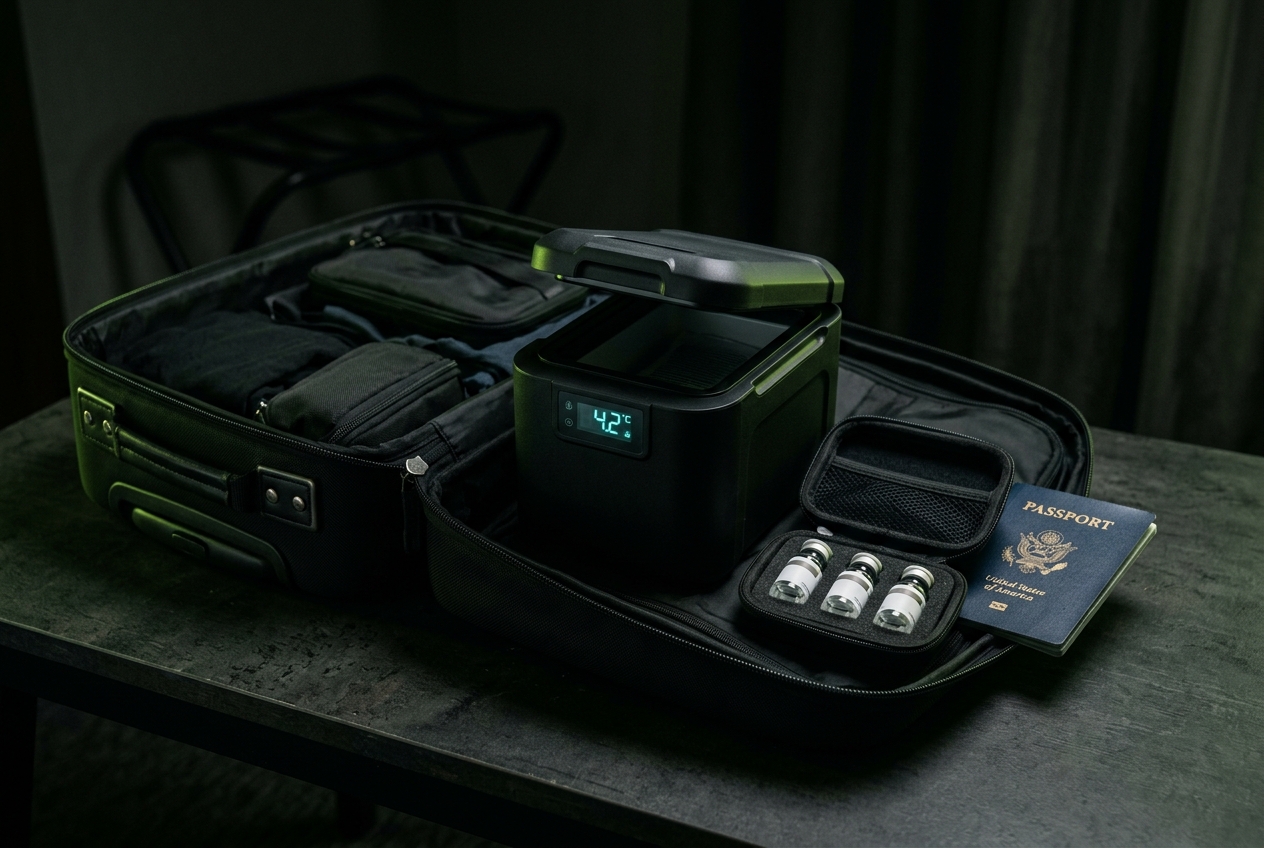
Where the PeptiCool touch-screen cooler fits

PeptiCool markets its 2026 touch-screen model as a rechargeable portable cooler for medication and temperature-sensitive items. The product page lists adjustable temperature control from 0–18°C, a 10,600mAh battery, USB/power-bank/car power options, and capacity for approximately 8–12 standard vials or 1–3 injector pens. Those features may suit travelers who want active cooling and a visible temperature reading instead of relying only on loose ice packs.

Match any setting to the instructions for your medication, test the unit before travel, and verify current carrier and security rules for its battery.

Quick packing checklist

  • Medication in clearly identified packaging
  • Label storage instructions or patient information
  • Travel cooler appropriate for the labeled range
  • Charging cable, wall adapter, and compatible power bank
  • Prescription details and clinician/pharmacy contacts
  • Required needles or supplies in a safe case
  • A plan for delays and temperature excursions
  • Current TSA, airline, and destination-country guidance

The bottom line

Effective travel storage is not about making every peptide as cold as possible. It is about keeping a specific medication within its labeled conditions, protecting it from avoidable heat or freezing, and having a plan when travel changes. Confirm the requirements, keep medication accessible, test your equipment, and ask a pharmacist when you are uncertain.

Keep reading

Sources

Research-Grade Peptides

Discount auto-applied

Third-party tested, made in the USA by American Peptide Research. Our link applies your discount automatically.

Affiliate links. For research use only — not for human consumption.

Peptide Dosage Calculator

Full calculator with presets

Was this article helpful?

peptidestravelstoragemedicationTSAcoolerPeptiCool

For educational purposes only — not medical advice. Consult a healthcare professional before starting any peptide protocol. Editorial policy

Recommended Reading

Retatrutide & Cancer Prevention: The Science Behind Tumor Reduction
Peptides

Retatrutide & Cancer Prevention: The Science Behind Tumor Reduction

peptides

Discover how retatrutide's triple-agonist mechanism fights cancer through metabolic intervention. Science-backed guide covering the 65% tumor reduction study, liver health, and immune reprogramming.

22 min read
Read
Peptide Blends Exposed: Why GLOW & KLOW Are Dead on Arrival
Peptides

Peptide Blends Exposed: Why GLOW & KLOW Are Dead on Arrival

peptides

GLOW and KLOW peptide blends violate basic chemistry. GHK-Cu needs pH 5.5-6.5, BPC-157 needs 7.4. The result? 60%+ potency loss, degradation, and wasted money.

18 min read
Read
AOD-9604: The Fat-Loss Peptide — Dosage, Benefits & Results
Peptides

AOD-9604: The Fat-Loss Peptide — Dosage, Benefits & Results

peptides

What AOD-9604 is, how the fragment 176-191 peptide works for fat loss, commonly reported dosing (250-300 mcg/day), realistic results, side effects and legal status - with sources.

8 min read
Read
MK-677 (Ibutamoren): Dosage, Benefits, Cycle & Side Effects
Peptides

MK-677 (Ibutamoren): Dosage, Benefits, Cycle & Side Effects

peptides

MK-677 dosage (10-25 mg/day), how and when to take ibutamoren, benefits, cycle length, side effects, and whether it's a SARM. Commonly reported protocols, sourced.

7 min read
Read
MOTS-c vs Metformin: The Longevity Comparison You Need to Read
Peptides

MOTS-c vs Metformin: The Longevity Comparison You Need to Read

peptides

Two of the most talked-about longevity compounds go head-to-head. MOTS-c (the exercise mimetic peptide) vs. Metformin (the diabetes drug turned anti-aging darling).

10 min read
Read
Blood Tests Before Peptides: The Complete Pre-Protocol Lab Guide
Peptides

Blood Tests Before Peptides: The Complete Pre-Protocol Lab Guide

peptides

Complete guide to pre-peptide blood testing. Learn which biomarkers to check before BPC-157, Retatrutide, or MK-677—plus where to order labs without a doctor.

18 min read
Read