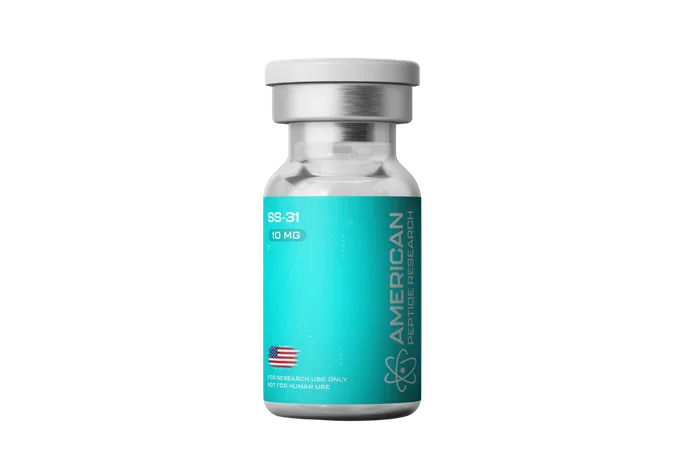
You're looking for clarity on SS-31 peptide dosing because general fitness advice doesn't cut it when you're optimizing mitochondrial function for endurance performance. The ss31 peptide dosage chart breaks down into three core tiers: baseline dosing (0.5-1 mg daily), moderate protocols (1-2 mg daily), and advanced endurance applications (10-15 mg per week). Your dose depends on your body weight, training volume, age, and recovery goals. The most common protocol among serious athletes is 5 mg taken three times per week via subcutaneous injection.
This guide walks you through every dosing tier, timing strategies, and cycling protocols so you can dial in the right dose for your performance goals. Refuse to settle for guesswork when the data is this clear.
Understanding SS-31 Baseline Dosing
Your starting point matters. Most athletes begin with either 0.5 mg once daily or 1 mg once daily, depending on body weight and training intensity.
The 0.5 mg daily dose is your entry-level protocol. You're introducing the peptide to your system without overwhelming your mitochondria. This works best if you're under 180 pounds, training 4-5 days per week, or managing recovery from a heavy training block. Inject in the morning or 30-60 minutes before your primary training session.
The 1 mg daily dose is the standard baseline. Most athletes in the 180-220 pound range and training 5-6 days per week land here. This is enough to measurably support mitochondrial energy production without overshooting your system's adaptation capacity. You'll run this for 4-6 weeks before deciding whether to hold, increase, or cycle off.
If you're building a performance protocol tailored to your metrics, your body weight and current VO2 max should inform whether you start at 0.5 or 1 mg daily.
The Moderate Dosage Tier: 1-2 mg Daily
Once you've adapted to baseline dosing over 4-6 weeks, you can progress to 1.5-2 mg daily if your goals demand it.
The 1.5 mg daily dose bridges the gap between baseline and advanced protocols. You're now targeting more aggressive mitochondrial adaptation, which makes sense if you're training for a HYROX competition or running high-volume endurance blocks. Your recovery capacity and training intensity should both be high at this tier. Inject once daily in the morning or pre-workout.
The 2 mg daily dose is the upper end of daily dosing for research protocols. Athletes at this level are typically heavy-training specialists, weighing 220+ pounds, with 8+ weeks of SS-31 adaptation already logged. This dose accelerates mitochondrial biogenesis but requires solid sleep, nutrition, and periodized training to avoid hitting a plateau.
Don't rush to this tier. Incremental progression (0.5 mg increases every 4-6 weeks) keeps you from adapting so fast that the peptide stops working.
Advanced Protocols: 10-15 mg Per Week
Heavy endurance athletes sometimes use weekly dosing schedules instead of daily micro-dosing. This is where the real progression lives.
A typical advanced protocol looks like this: 5 mg injected three times per week (Monday, Wednesday, Friday). That totals 15 mg per week, distributed across your training week. The advantage is that you're timing larger doses around your hardest training days, which amplifies the mitochondrial signaling effect when your energy demand is highest.
Some athletes prefer 10 mg per week split as 3.3 mg every other day, or 5 mg twice per week. The weekly volume matters more than the frequency pattern. Your job is finding the schedule that aligns with your training calendar.
This tier is not entry-level. You need 12+ weeks of consistent baseline or moderate dosing before moving here. Your body has to be adapted to the peptide's effects, otherwise the higher dose won't translate to better performance. It'll just accelerate tolerance.
SS-31 Dosage Chart by Individual Factors
Your dose isn't one-size-fits-all. These variables should guide your protocol selection:
Related: Peptide Dosage Chart: Complete Guide for Athletes
- Body weight under 180 lbs: Start at 0.5 mg daily, progress to 1-1.5 mg daily. Weekly max around 7-10 mg.
- Body weight 180-220 lbs: Start at 1 mg daily, progress to 1.5-2 mg daily. Weekly max around 10-15 mg.
- Body weight over 220 lbs: Start at 1 mg daily, progress to 2 mg daily. Weekly protocols of 15 mg are appropriate if adapted.
- Training volume 4-5 days/week: Baseline protocols (0.5-1 mg daily) are sufficient.
- Training volume 6+ days/week: Moderate to advanced protocols (1-2 mg daily or 10-15 mg weekly).
- Age 25-35: You can progress faster; baseline to moderate in 8-12 weeks.
- Age 35+: More conservative progression; baseline for 8+ weeks before advancing.
- Recovery quality poor: Hold your current dose or reduce by 25%. Sleep and nutrition must improve first.
Don't eyeball this. Write down your weight, training days, sleep average, and current baseline dose. That's your starting benchmark.
Injection Timing and Administration
When you inject SS-31 matters almost as much as how much you inject.
Morning injection (6-8 AM) is the most common approach. You're timing the peptide's mitochondrial activation with your waking metabolic state. This works especially well if you train later in the day, because the peptide has 8-12 hours to prime your energy systems before the workout stress arrives.
Pre-workout injection (30-60 minutes before training) is the alternative. You're frontloading the mitochondrial signal directly into your training stimulus. This is smarter if you're doing high-intensity sessions and want acute energy production gains. Save this approach for sessions where you're targeting power or VO2 max work.
Subcutaneous injection is the standard delivery method. Inject into the abdomen, thigh, or shoulder using a 28-31 gauge insulin syringe. The peptide requires reconstitution before use, so you'll be mixing it with bacteriostatic water or sterile saline. Expect a simple protocol that takes 2-3 minutes per injection.
Athletes who track their protocols systematically often log injection time alongside training data to spot patterns in recovery and performance markers.