The Art That Does Not Fight
Aikido is a Japanese martial art founded by Morihei Ueshiba (known as O-Sensei) in the early 20th century. Unlike most martial arts, Aikido's core principle is not to defeat an opponent but to neutralize aggression without causing unnecessary harm. The name itself reveals the philosophy: Ai (harmony) + Ki (energy/spirit) + Do (way) — "The Way of Harmonious Spirit."
How Aikido Works
Aikido techniques use an attacker's momentum and energy against them through:
Irimi (Entering)
Moving into an attack rather than retreating. By closing the distance at an unexpected angle, the aikidoka disrupts the attacker's balance and takes control of the encounter.Tenkan (Turning)
Pivoting to redirect the attacker's force in a circular motion. Instead of meeting force with force, the aikidoka blends with the attack and guides it past them.Joint Locks (Kansetsu-waza)
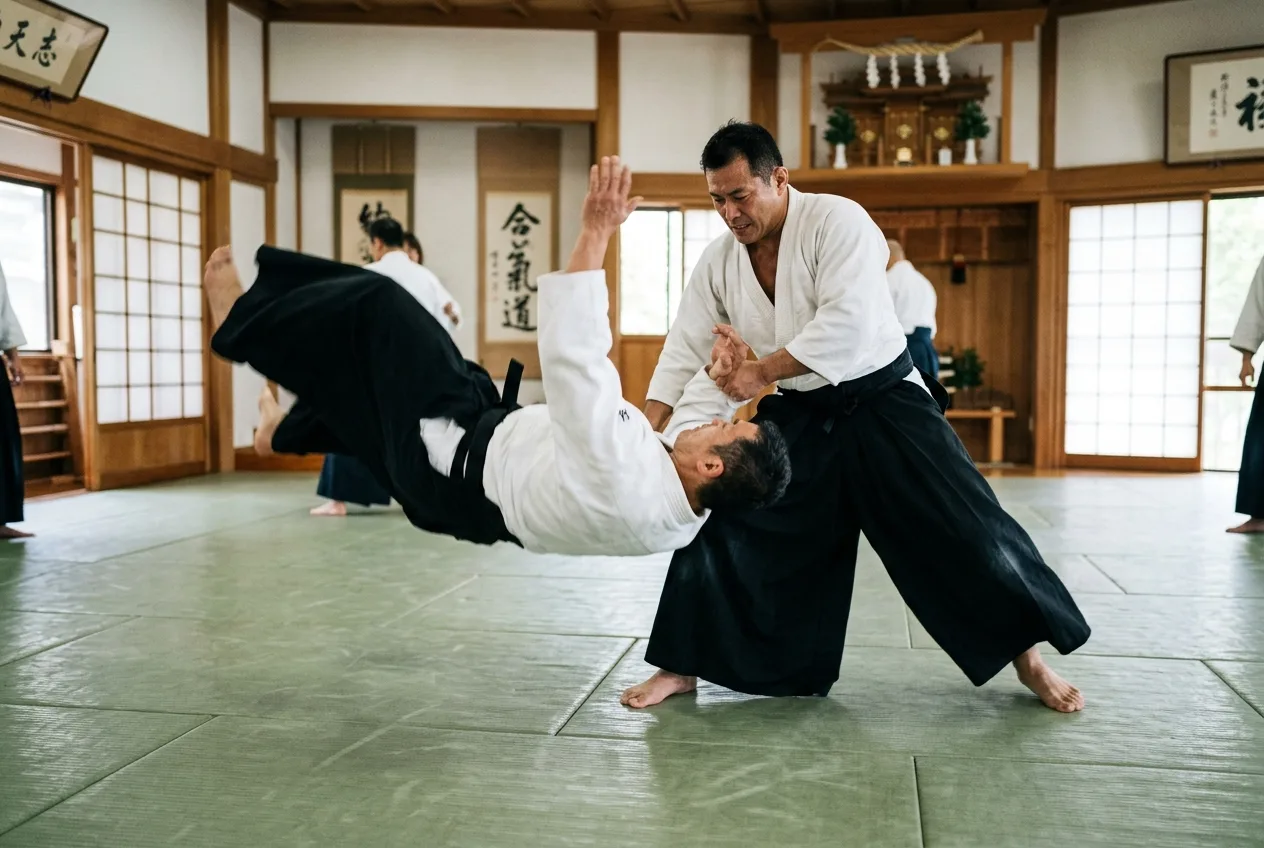
Aikido employs sophisticated joint manipulations — particularly of the wrist, elbow, and shoulder — that control an attacker without strikes. Applied correctly, these locks can immobilize someone with minimal force.Throws (Nage-waza)
Using circular movement and leverage to unbalance and throw an attacker. Aikido throws emphasize controlled projection rather than slamming.The Philosophy
Ueshiba was a deeply spiritual man who studied multiple martial arts before creating Aikido. His vision was revolutionary: a martial art whose highest expression is not victory over others but victory over one's own aggression.
Key philosophical principles:
- Non-resistance: Do not oppose force with force
- Harmony with nature: Movement should be circular, like water
- Compassion: Protect both yourself and your attacker
- Continuous improvement: The path has no endpoint
The Controversy
Aikido is one of the most debated martial arts in the combat sports community. Critics argue:
- Techniques are practiced against compliant partners (uke)
- No competitive sparring limits real-world applicability
- Many dojos lack pressure testing
- Aikido's principles are used effectively in law enforcement
- The art's value is in de-escalation, not fighting
- Joint locks and control techniques are used in multiple combat systems
Who Should Practice Aikido
Aikido is excellent for:
- People seeking martial philosophy alongside physical practice
- Law enforcement and security professionals who need control without damage
- Older practitioners — Aikido is gentle on the body compared to striking arts
- Those recovering from aggressive tendencies — the practice explicitly teaches non-aggression
Getting Started
Look for a dojo affiliated with a recognized organization (Aikikai, ASU, USAF). Visit multiple dojos before committing — teaching styles vary dramatically. Expect to spend your first year learning how to fall safely (ukemi) before advanced techniques.