Key Takeaways
- Runners who rotated between multiple pairs of shoes had a 39% lower injury risk than single-shoe runners. — Malisoux et al., Scandinavian Journal of Medicine & Science in Sports, 2015 (264 runners, 22 weeks)
- Increasing step rate 10% above preferred reduced peak patellofemoral joint force by 14%. — Lenhart et al., Medicine & Science in Sports & Exercise, 2014 (30 healthy adults, instrumented treadmill)
- The "180 steps per minute" target is a misread of a 1984 Olympic observation, not a prescription for recreational runners. — Daniels, Daniels' Running Formula; contested by every biomechanist we found
- Rinsing a carbohydrate drink and spitting it out improves performance without swallowing a gram, and works best fasted. — Brietzke et al., Sports Medicine, 2019 (meta-analysis)
- Ice slurry before exercise in the heat produced a moderate pooled performance effect (Hedges g = 0.54) at doses near 7–10 g per kg. — Pooled meta-analysis of precooling trials
- Three of the eight tips below have no controlled trial behind them. We say which ones.
Last updated: August 5, 2026 · Written by Daniel Rivas, Founder, NinjAthlete (Dallas, Texas) · HYROX athlete, sub-60 finish (59:51)
Rotating between two pairs of running shoes instead of one was associated with a 39% lower injury risk across 264 runners tracked for 22 weeks. That is a larger effect than most supplements you have been sold, and it costs nothing beyond owning a second pair you were going to buy eventually.
This page is the source list behind our eight-slide breakdown. Every claim below carries the study, the sample size, and the honest effect size, including the three tips that have no trial behind them at all. Most running advice circulates without any of that. The point of this page is that you can check it.
 Step rate is the most-studied variable on this page. Two separate University of Wisconsin–Madison labs quantified it in 2011 and 2014.
The eight tips, ranked by how good the evidence actually is
Not all eight are equal. Two are backed by controlled trials with real sample sizes, three are backed by meta-analysis, and three are coaching practice we use but cannot point to a trial for.
| # | Tip | Effect found | Evidence | Sample |
|---|---|---|---|---|
| 1 | Rotate two pairs of shoes | 39% lower injury risk | Prospective cohort | 264 runners, 22 weeks |
| 2 | Raise cadence ~5–10% | 14% less peak patellofemoral force at +10% | Lab trial + modelling | 30 adults |
| 3 | Carb mouth rinse, spit it out | Small but real, strongest fasted | Meta-analysis | Multiple trials pooled |
| 4 | Ice slurry before a hot race | Moderate (g = 0.54) | Meta-analysis | Pooled precooling trials |
| 5 | Keep easy runs genuinely easy | ~80% of elite volume sits below threshold | Observational + trial | Elite cohorts |
| 6 | Run controlled downhills | Repeated bout effect is well established | Mechanistic literature | Varies |
| 7 | Add strides to easy runs | No controlled trial isolating strides | Coaching practice | None |
| 8 | Train compromised running | No controlled trial isolating it | Coaching practice | None |
Source: full citations in the Sources and Methodology section below.
Does rotating running shoes actually prevent injury?
Yes, and it is the single best-evidenced tip on this page. Malisoux and colleagues tracked 264 recreational runners for 22 weeks in a 2015 study published in the Scandinavian Journal of Medicine & Science in Sports. Runners who rotated between multiple pairs had a hazard ratio of 0.61 for running-related injury, meaning roughly a 39% lower risk than single-shoe runners.
The proposed mechanism is load variation. Different midsole geometry, stack height and drop shift where force travels through the foot, ankle and shin. Alternating them spreads that load across slightly different tissue rather than driving the same pattern into the same structures every session.
We apply the same sourcing standard across the full article library. Two caveats worth stating. This was a prospective cohort, not a randomised trial, so it shows association rather than proof of cause. And it does not tell you the shoes need to be different models, only that participants who rotated fared better.
 Malisoux et al. followed 264 runners for 22 weeks. Shoe rotation was one of the few modifiable factors that reached significance.
How do you increase your running cadence, and how much does it help?
Increase it by about 5% at a time, not 10%, and expect a meaningful reduction in knee loading rather than a magic fix. Lenhart and colleagues recorded 30 healthy adults on an instrumented treadmill at 90%, 100% and 110% of preferred step rate. Running at 110% reduced peak patellofemoral joint force by 14%.
Heiderscheit and colleagues, working in the same University of Wisconsin–Madison group, recorded 45 recreational runners across the same conditions in 2011. They found less mechanical energy absorbed at the knee and hip when step rate rose, along with reduced braking impulse, shorter step length and less vertical movement of the centre of mass.
The practical instruction is narrow. Take your current cadence, add 5%, hold that. Both papers used ±5% and ±10% conditions, and the 2011 group noted that larger jumps shift load toward the ankle and increase the metabolic cost of running.
What is a good running cadence, and is 180 the target?
There is no single correct number, and 180 is not a target. The figure traces to Jack Daniels observing distance runners at the 1984 Olympics, nearly all of whom ran above 180 steps per minute. Those were elite athletes racing. It was a description of what fast people already did, not a prescription for what everyone should do.
Cadence varies with height, leg length, pace and fitness. Taller runners with longer levers cover the same ground with fewer steps. The useful number is not 180, it is your own current cadence plus 5%.
How do you measure your running cadence?
Count how many times one foot strikes the ground in 30 seconds, then multiply by four. That gives total steps per minute for both feet, which is the number every study above refers to. Most running watches report it automatically under cadence or steps per minute.
Measure across several runs rather than one. Cadence drifts with pace, fatigue, terrain and even how recently you ate, so a single reading on a fast day will overstate your baseline and make your 5% target too aggressive.
Take the average of your easy runs specifically. That is the setting where you have the attention to change anything, and it is where both Wisconsin studies applied their manipulations.
How long does it take to change your cadence?
Expect two to three weeks per 5% step, and expect it to feel unnatural for the first several runs. Your neuromuscular system has a strongly preferred step rate and it defends it, which is why the change fades the moment you stop paying attention.
One small study offers a useful hint about making it stick. Seven runners, all below 170 steps per minute, ran to music set 7.5% to 10% above their normal cadence for four weeks. Cadence rose about 8.5% during the intervention and remained about 7.9% higher for three to five weeks afterwards, with no change in speed or heart rate.
Treat that as a promising pilot, not a settled finding. Seven participants is a very small sample, and no one has replicated it at scale. The mechanism is plausible and the intervention is free, which is a reasonable basis for trying it and a poor basis for claiming it works.
Does cadence matter more than foot strike?
For most runners, yes, because cadence is far easier to change and carries less risk. Deliberately switching from a heel strike to a forefoot strike shifts load abruptly onto the calf and Achilles, and that transition is a well-documented route to injury.
Raising step rate tends to move your foot closer to landing under your hip anyway. Heiderscheit and colleagues recorded shorter steps, reduced braking impulse and less vertical movement of the centre of mass at higher step rates, without anyone consciously changing how their foot met the ground.
The practical order is cadence first, and foot strike only if a clinician tells you to.
Try it: the cadence step-up calculator
Enter your current cadence to see the progression both studies actually tested. The default table shows a runner starting at 160 steps per minute.
Cadence step-up calculator
Both Wisconsin studies tested 5% and 10% increases from preferred step rate. Hold each step for two to three weeks before moving up.
| Phase | Target cadence | Change | What the research says |
|---|---|---|---|
| Current | 160 spm | Baseline | Measure over several runs, not one |
| Weeks 1–3 | 168 spm | +5% | Reduced knee energy absorption (Heiderscheit 2011) |
| Weeks 4–6 | 176 spm | +10% | 14% lower peak patellofemoral force (Lenhart 2014) |
Above +10% the research shows rising metabolic cost and load shifting toward the ankle. Increase slowly and stop if calves or Achilles complain.
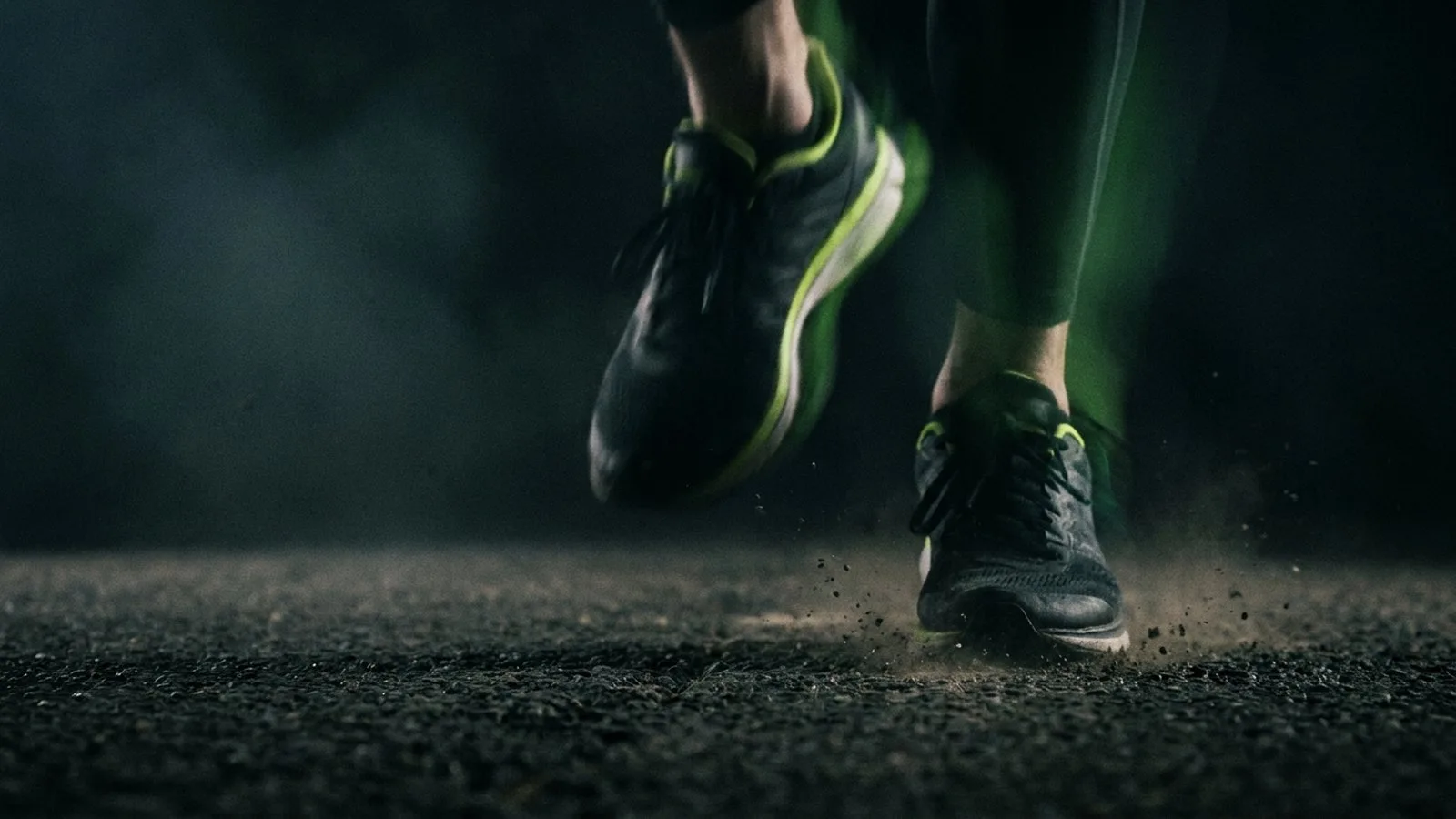 Lenhart et al. modelled 30 adults at 90%, 100% and 110% of preferred step rate. Only the 110% condition produced the 14% figure.
Does carb rinsing work if you spit it out?
Yes, and you do not have to swallow it. Rinsing a carbohydrate solution around your mouth for roughly 5 to 10 seconds and spitting it out improves endurance performance, an effect first shown by Carter and colleagues in 2004 and confirmed across pooled trials by Brietzke and colleagues in Sports Medicine in 2019.
The mechanism is not nutritional. Receptors in the mouth detect carbohydrate and signal reward and motor areas of the brain, which raises central drive before any fuel reaches the gut. That is why it works without swallowing.
Two honest limits. The effect is small, and it is clearest when you are fasted or low on carbohydrate. If you have already eaten a normal pre-run meal, expect little. It is most useful on hard efforts under about an hour, where taking on fuel is impractical anyway.
Should you drink a slushie before running in the heat?
In genuinely hot conditions, yes. Ice slurry consumed before exercise lowers core temperature and increases the heat you can absorb before performance falls apart. Pooled precooling trials produced a moderate effect, around Hedges g = 0.54, at doses in the region of 7 to 10 grams per kilogram of body weight in the 30 minutes before starting.
For a 70 kg runner that is roughly 500 to 700 ml of slush, which is a large volume to take on immediately before racing. Practise it in training before you try it on a start line.
In mild weather it does close to nothing. The mechanism depends on having heat storage capacity to buy, and if you are not going to overheat there is nothing to gain.
How slow should your easy runs be?
Slow enough to hold a full conversation, which for most runners is slower than feels right. Analyses of elite endurance athletes by Seiler and Kjerland in 2006, and subsequent controlled work by Stöggl and Sperlich in 2014, found roughly 80% of training volume sits below the first ventilatory or lactate threshold, with a small hard fraction above it.
The failure mode is the middle. Moderate-intensity running is hard enough to accumulate fatigue and blunt your next quality session, but not hard enough to drive the adaptations a genuine hard session produces. You pay the cost without buying the benefit.
The check is conversational, not numerical. If you cannot speak in complete sentences, you are not running easy, whatever your watch says. If you prefer a number to anchor it, our heart rate zone calculator will set a ceiling for zone 2.
Are downhill runs actually a strength session?
Yes, mechanically. Running downhill loads muscle eccentrically, meaning the muscle produces force while lengthening. That is the loading pattern that destroys quadriceps late in a marathon, and it is also the pattern that protects against it.
The relevant mechanism is the repeated bout effect, one of the more robust findings in exercise physiology. A single bout of unfamiliar eccentric work causes soreness and temporary strength loss, and the same bout repeated weeks later causes markedly less. You are buying protection by paying the cost early.
Practical version: 4 to 6 controlled downhill reps on a moderate grade, focused on quick light steps rather than braking. Never in race week, because the soreness window is real.
What are strides and do they do anything?
Strides are 6 by 20 seconds near top speed at the end of an easy run with full recovery between each. They keep turnover and coordination sharp during long base blocks, and they cost about five minutes.
Here is the honest part. We could not find a controlled trial isolating strides as a variable and measuring an outcome. The rationale is neuromuscular and the practice is near-universal among coaches, but the evidence is inference from related work on plyometric and sprint training, not a study of strides themselves.
We include it because the cost is trivial and the mechanism is plausible. That is a different standard of proof from the shoe rotation finding, and it should be treated differently.
Should you practise running tired instead of fresh?
If you race HYROX, obstacle events or triathlon, yes. Everyone runs their intervals fresh and nobody races fresh. Compromised running means deliberately running immediately after loaded work: sled push then 400m, burpee broad jumps then 400m.
This is coaching practice, not a controlled finding. There is a body of research on the run leg of triathlon showing altered mechanics and economy after cycling, which supports the general principle that pre-fatigue changes how you run. Extending that to specific station-to-run transitions is reasonable inference, not proven transfer.
The value is calibration. Most runners have no idea what their 400m pace feels like with a heart rate already at threshold, and race day is a poor time to find out. Our HYROX pace card builder will give you station-by-station splits to rehearse against.
The claims everyone repeats that do not survive checking
| Claim as circulated | Where it spreads | What the source actually says |
|---|---|---|
| "180 spm is the optimal cadence" | Coaching blogs, watch marketing | Daniels observed elite runners at the 1984 Olympics were above 180. It described elites racing, not a target for everyone |
| "Increasing cadence cuts knee load 20%" | Fitness social media | Lenhart 2014 found 14%, and only at +10% step rate, in 30 adults |
| "Music raises your cadence permanently" | Running press | One 2020s study used 7 runners. Cadence rose 8.5% and held at 7.9% for 3–5 weeks. That is a pilot, not a settled finding |
| "Shoe rotation prevents injury" | Retail marketing | The 39% figure is from an observational cohort, which shows association, not proven cause |
Source: each row traced to the primary paper listed in Sources and Methodology.
Get all eight studies as a one-page PDF
Every paper on this page with its sample size, effect size and a direct link. The same list we send when people comment RECEIPTS on the carousel.
 Precooling works by increasing heat storage capacity. That advantage only exists when conditions are hot enough to threaten it.
How to actually apply these without wrecking your training
Change one variable at a time, and give each one three weeks. The most common failure we see is a runner reading a list like this and simultaneously raising cadence, slowing every easy run and adding downhill reps, then having no idea which change caused the calf strain.
Order matters. Start with the two that carry the strongest evidence and the lowest risk: buy the second pair of shoes, and slow your easy runs down. Neither can injure you.
Add cadence work next, at 5%, held for two to three weeks before you touch 10%. Leave downhills until you have a base, and keep them out of race week entirely.
The Log: one evidence breakdown a week
We read the paper, check the sample size and tell you when the evidence is thin. No hype, no supplement pitches.
Frequently Asked Questions
What is a good running cadence?
There is no universal number. Cadence depends on height, leg length, pace and fitness, and taller runners naturally take fewer steps. Rather than chasing 180 steps per minute, measure your own average over several runs and work toward roughly 5% above it.
How do you increase your running cadence safely?
Add about 5% to your current cadence and hold it for two to three weeks before increasing again. Both University of Wisconsin studies tested 5% and 10% conditions. Jumping straight to 10% raises metabolic cost and shifts load toward the ankle and Achilles.
Is 180 steps per minute the ideal running cadence?
No. The figure comes from Jack Daniels observing elite distance runners at the 1984 Olympics, nearly all of whom exceeded 180 while racing. It describes what fast athletes already did. It was never established as a target for recreational runners.
Does carb rinsing actually work without swallowing?
Yes. Rinsing a carbohydrate drink for 5 to 10 seconds and spitting it out improves endurance performance by stimulating mouth receptors that raise central drive. The effect is small and clearest when fasted or low on carbohydrate, and it suits efforts under about an hour.
How many pairs of running shoes should you rotate?
At least two. In a 22-week study of 264 runners, those rotating between multiple pairs had roughly 39% lower injury risk than single-shoe runners. The study did not establish an optimal number or require the pairs be different models.
How slow should easy runs be?
Slow enough to speak in complete sentences. Elite endurance athletes place roughly 80% of training volume below the first threshold. Moderate-intensity running accumulates fatigue without producing the adaptations of a genuinely hard session.
Does drinking a slushie before a race improve performance?
In hot conditions, yes. Ice slurry at roughly 7 to 10 grams per kilogram of body weight in the 30 minutes before exercise lowers core temperature and produced a moderate pooled effect in precooling trials. In mild weather it offers no meaningful benefit.
Is downhill running good for marathon training?
Yes, when controlled. Downhill running loads muscle eccentrically, the same pattern that damages quadriceps late in a marathon. Repeating that exposure triggers the repeated bout effect, so later sessions cause less damage. Keep it out of race week.
Do running strides improve performance?
Probably, but the direct evidence is thin. We found no controlled trial isolating strides and measuring an outcome. The neuromuscular rationale is sound and coaching adoption is near-universal, so we include it while being clear it is weaker evidence than the shoe or cadence findings.
What is compromised running in HYROX training?
Compromised running means running immediately after loaded work, such as a sled push or burpee broad jumps, to rehearse race conditions. No controlled trial isolates it. Related triathlon research shows pre-fatigue alters running mechanics, which supports the principle without proving the specific transfer.
Sources and Methodology
-
Malisoux L, Ramesh J, Mann R, Seil R, Urhausen A, Theisen D. "Can parallel use of different running shoes decrease running-related injury risk?" Scandinavian Journal of Medicine & Science in Sports, 2015;25(1):110–115. Prospective cohort, 264 recreational runners, 22 weeks. Hazard ratio 0.61 for multiple-shoe users. PubMed 24286345
-
Lenhart RL, Thelen DG, Wille CM, Chumanov ES, Heiderscheit BC. "Increasing running step rate reduces patellofemoral joint forces." Medicine & Science in Sports & Exercise, 2014;46(3):557–564. 30 healthy adults, instrumented treadmill, 90/100/110% of preferred step rate. Peak patellofemoral joint force reduced 14% at 110%. PubMed 23917470
-
Heiderscheit BC, Chumanov ES, Michalski MP, Wille CM, Ryan MB. "Effects of step rate manipulation on joint mechanics during running." Medicine & Science in Sports & Exercise, 2011;43(2):296–302. 45 healthy recreational runners, ±5% and ±10% step rate conditions. PubMed 20581720
-
Brietzke C, Franco-Alvarenga PE, Coelho-Júnior HJ, Silveira R, Asano RY, Pires FO. "Effects of carbohydrate mouth rinse on cycling time trial performance: a systematic review and meta-analysis." Sports Medicine, 2019;49(1):57–66. Pooled trials; effect clearest in fasted or carbohydrate-depleted states. PubMed 30467788
-
Carter JM, Jeukendrup AE, Jones DA. "The effect of carbohydrate mouth rinse on 1-h cycle time trial performance." Medicine & Science in Sports & Exercise, 2004;36(12):2107–2111. The original demonstration that rinsing without ingestion improves performance. PubMed 15570147
-
Seiler S, Kjerland GØ. "Quantifying training intensity distribution in elite endurance athletes: is there evidence for an 'optimal' distribution?" Scandinavian Journal of Medicine & Science in Sports, 2006;16(1):49–56. Basis of the roughly 80/20 distribution figure. PubMed 16430681
-
Stöggl T, Sperlich B. "Polarized training has greater impact on key endurance variables than threshold, high intensity, or high volume training." Frontiers in Physiology, 2014;5:33. Controlled comparison of intensity distributions. PubMed 24550842
-
Daniels J. Daniels' Running Formula, Human Kinetics. Origin of the 180 steps-per-minute observation, recorded at the 1984 Olympic Games among elite distance runners.
-
Music-paced cadence pilot. A 12-week single-case-design study of 7 runners (all below 170 spm) using a musical beat 7.5–10% above preferred cadence. Cadence rose ~8.5% during the intervention and held at ~7.9% for 3–5 weeks after, with no change in speed or heart rate. Sample size is very small and the finding is unreplicated; treated on this page as a pilot.
Ice slurry precooling. The pooled effect cited (Hedges g = 0.54) comes from meta-analytic work on precooling and endurance performance in the heat. Individual trials vary substantially in dose, timing, exercise mode and ambient conditions, and some running-specific trials found core temperature reductions without matching performance gains. Treat the figure as directional.
What is not here. We could not find a controlled trial isolating running strides as an intervention, nor one isolating station-to-run compromised running in HYROX-format racing. Both appear on this page as coaching practice, labelled as such, because we use them and the mechanism is plausible. We also could not find a randomised trial of shoe rotation. The 39% figure is observational, and no one should present it as proven causation. If you find trials we missed, send them and we will update this page and say what changed.
About the Author
Daniel Rivas is the founder of NinjAthlete, a performance platform covering evidence-based training, recovery and longevity for athletes. He is a competitive HYROX athlete based in Dallas, Texas, with a sub-60 finish (59:51) and multiple races completed, including doubles.
NinjAthlete publishes evidence-first breakdowns and does not employ clinical staff. Nothing on this page is medical advice. See our tools and calculators or browse the full article library.
Related Reading
- HYROX training guides and race strategy — plans, station pacing and the compromised-running sessions referenced above.
- Free calculators for athletes — including heart rate zones for setting genuine easy-run ceilings and a HYROX pace card builder.
- The peptide hub — dosing protocols and evidence reviews, written to the same sourcing standard as this page.